A Message from Galvanize Action about a huge block of persuadable voters!
“White women are the largest voting bloc in this country and will be for decades to come. They account for 38% of the national vote share and 43% of the vote share across Galvanize Action’s priority states. Within this voting bloc, we’ve identified 44,093,812 moderate women who are not ideologically entrenched, meaning they are open to new ideas and perspectives and movable on key issues such as reproductive freedom, healthcare, gender equity, climate, and the economy.”
Galvanize Action has a fabulous interactive messaging worksheet we can all use!
Galvanize Action says, “We’ll share with you exactly how to create a message that meets people at their values and how to turn those into an effective ad. Our interactive worksheet will guide you through the process with prompts about your target audience and the issue you want to move them on. You’ll walk away with customized advice!”
This is the explosive look at the aftermath of the 2020 election–and the January 6th uprising–from ABC News’ chief Washington correspondent, Jonathan Karl. Jonathan Karl, the reporter who has known Donald Trump longer than any other White House correspondent, Karl told the story of Trump’s rise in the New York Times bestseller Front Row at the Trump Show. Now he tells the story of Trump’s downfall, complete with riveting behind-the-scenes accounts of some of the darkest days in the history of the American presidency and packed with original reporting and on-the-record interviews with central figures in this drama who are telling their stories for the first time.
Does power corrupt, or are corrupt people drawn to power? Are tyrants made or born? Are entrepreneurs who embezzle and cops who kill the result of poorly designed systems or are they just bad people? If you were suddenly thrust into a position of power, would you be able to resist the temptation to line your pockets or seek revenge against your enemies?
To answer these questions, Corruptible draws on over 500 interviews with some of the world’s top leaders—from the noblest to the dirtiest—including presidents and philanthropists as well as rebels, cultists, and dictators. Some of the fascinating insights include: how facial appearance determines who we pick as leaders, why narcissists make more money, why some people don’t want power at all and others are drawn to it out of a psychopathic impulse, and why being the “beta” (second in command) may actually be the optimal place for health and well-being.
Corruptible also features a wealth of counterintuitive examples from history and social science: you’ll meet the worst bioterrorist in American history, hit the slopes with a ski instructor who once ruled Iraq, and learn why the inability of chimpanzees to play baseball is central to the development of human hierarchies.
Fascism is a cult of the leader, who promises national restoration in the face of supposed humiliation by immigrants, leftists, liberals, minorities, homosexuals, women, in the face of what the fascist leader says is a takeover of the country’s media, cultural institutions, schools by these forces.
Fascist movements typically, though not invariably, rest on an urban/rural divide. The cities are where there’s decadence, where the elites congregate, where there’s immigrants, and where there’s criminality.
Each of these individuals alone is not in and of itself fascist, but you have to worry when they’re all grouped together, seeing the other as less than. Those moments are the times when societies need to worry about fascism.
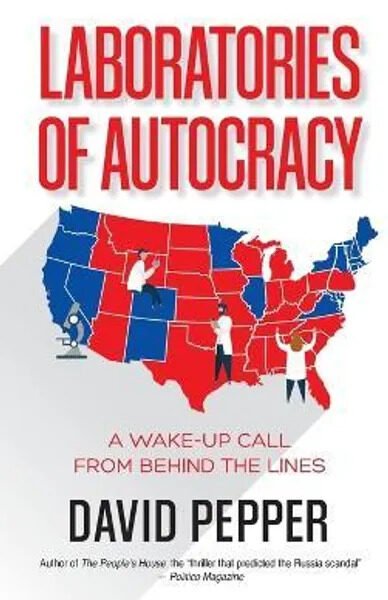
David Pepper shows that far more than the high-profile antics of national politicians and Trump himself, it’s anonymous, often corrupt politicians in statehouses across the country who pose the greatest dangers to American democracy. Amid all the chaos, these statehouses are hard at work, every day, hacking away at core principles and protections of our democratic system. And they’re getting more audacious every year.
Because these statehouses no longer operate as functioning democracies, these unknown politicians have all the incentive to keep doing greater damage, and can not be held accountable however extreme they get. This has driven steep declines in states like Ohio and others across the country. And collectively, it’s placed American democracy in its greatest peril since the dawn of the Jim Crow era.
But Pepper doesn’t stop there. He lays out a robust pro-democracy agenda outlining how everyone from elected officials to business leaders to everyday citizens can fight back.
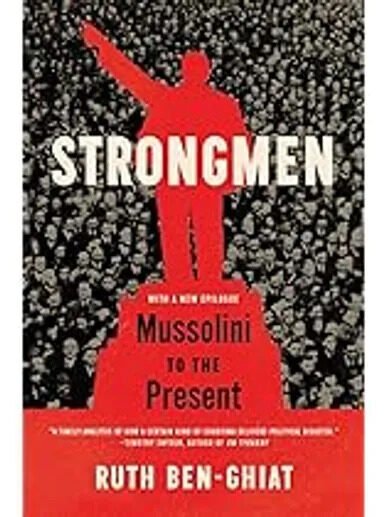
Ruth Ben-Ghiat is the expert on the “strongman” playbook employed by authoritarian demagogues from Mussolini to Putin—enabling her to predict with uncanny accuracy the recent experience in America and Europe. In Strongmen, she lays bare the blueprint these leaders have followed over the past 100 years, and empowers us to recognize, resist, and prevent their disastrous rule in the future.
A celebrated foreign-policy expert and key impeachment witness reveals how declining opportunity has set America on the grim path of modern Russia – and draws on her personal journey out of poverty, and her unique perspectives as a historian and policy maker, to show how we can return hope to our forgotten places.
Fiona Hill grew up in a world of terminal decay. The last of the local mines had closed, businesses were shuttering, and despair was etched in the faces around her. Her father urged her to get out of their blighted corner of northern England: “There is nothing for you here, pet,” he said.
The coal-miner’s daughter managed to go further than he ever could have dreamed. She studied in Moscow and at Harvard, became an American citizen, and served three U.S. Presidents. But in the heartlands of both Russia and the United States, she saw troubling reflections of her hometown and similar populist impulses. By the time she offered her brave testimony in the first impeachment inquiry of President Trump, Hill knew that the desperation of forgotten people was driving American politics over the brink—and that we were running out of time to save ourselves from Russia’s fate. In this powerful, deeply personal account, she shares what she has learned, and shows why expanding opportunity is the only long-term hope for our democracy.
Despotic leaders do not rule alone; they rely on political allies, bureaucrats, and media figures to pave their way and support their rule. The authoritarian and nationalist parties that have arisen within modern democracies offer new paths to wealth or power for their adherents.
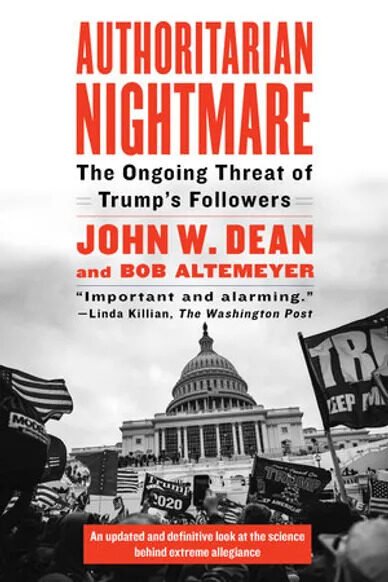
The Ongoing Threat of Trump's Followers / Trump and His Followers
by John W. Dean
and Bob Altemeyer
Publisher: Melville House
John Dean, of Watergate fame, joined with Bob Altemeter, an expert on authoritarianism, to look at the entirety of the Trump phenomenon, using psychological and social science studies, as well as polling analyses, to understand Donald Trump’s followers. How did America end up with a leader who acts so crudely and despotically, and counter to our democratic principles? Why do his followers stick with him, even when he acts against their interests?
Deb Lavoy explains how we fall for disinformation and how to train ourselves to avoid falling for it. (11 min.)
Deb Lavoy is on a mission to eradicate disinformation. As a former software engineer and digital marketer, she recognized the established social media marketing techniques that disinformation perpetrators appropriating to manipulate us into believing falsehoods. This talk provides tips on recognizing these tricks and how to counter them. Deb Lavoy is on a mission to eradicate disinformation. Her experience in software engineering and marketing, gave her a unique perspective on the rise of disinformation in 2016: the perpetrators were maliciously appropriating tried and tested digital marketing techniques. Deb founded the nonprofit Reality Team in response.
Reality Team drowns out the lies perpetrated over social media with simply stated truths, and arms people with tools and information to join the fight. The organization builds campaigns that change the ratio of truthful to untruthful information on social media feeds and provides tools and techniques to make it easier to tell the difference.
Robert Reich’s is Chancellor’s Professor of Public Policy at the University of California at Berkeley and Senior Fellow at the Blum Center. He served as Secretary of Labor in the Clinton administration for which Time Magazine named him one of the 10 most effective cabinet secretaries of the twentieth century. He has written 18 books, including
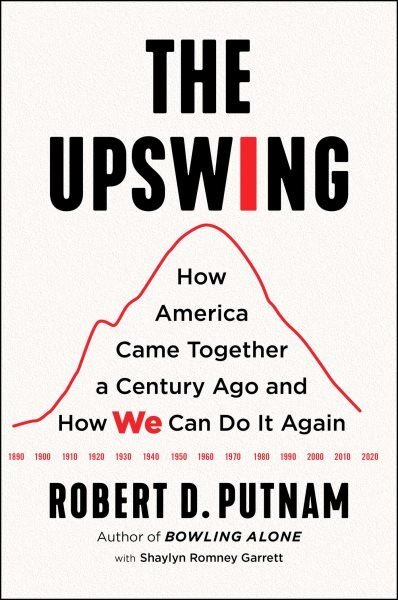
how America came together a century ago and how we can do it again
by Robert D. Putnam
and Shaylyn Romney Garrett.
Publisher: Simon & Schuster
“An eminent political scientist’s brilliant synthesis of social and political trends over the past century that shows how we have gone from an individualistic society to a more communitarian society and then back again — and how we can use that experience to overcome once again the individualism that currently weakens our country”
We can’t go back to when things were “good.” But we can learn from when things ware “bad.” In the early 1900’s the Guilded Age of the robber barons, things were really bad for most US citizens; they feared for the end of democracy and the take-over by the oligarchs.
America’s Secession Threat and How to Restore Our Nation
by David French
Summary
Reestablishing national unity will require the bravery to commit ourselves to embracing qualities of kindness, decency, and grace towards those we disagree with ideologically. David French calls on all of us to demonstrate true tolerance so we can heal the American divide. If we want to remain united, we must learn to stand together again.
A Leading Cult Expert Explains How the President Uses Mind Control
by Steve Hassan
Publisher: Free Press
Mind control and licensed mental health expert Steven Hassan draws parallels between our 45th president and people like Jim Jones, David Koresh, Ron Hubbard, and Sun Myung Moon, arguing that this presidency is in many ways like a destructive cult. He specifically details the ways in which people are influenced through an array of social psychology methods and how they become fiercely loyal and obedient.
Dr. Steven Hassan’s presentation to Commonwealth Club of CA
Timothy Snyder provides a stark warning for the future of American democracy. Too easily we are ignoring the ways in which tyranny starts to eat away at democracy. As our political system faces new threats – not unlike those faced by democracies in the 20th century – we must look to the past to safeguard our future.
INTERVIEW: Listen to Professor Snyder discuss his book at Politics and Prose Bookstore
Why Good People Are Divided by Politics and Religion
by Jonathan Haidt
Drawing on his twenty-five years of groundbreaking research on moral psychology, Jonathan Haidt shows how moral judgments arise not from reason but from gut feelings. He shows why liberals, conservatives, and libertarians have such different intuitions about right and wrong, and he shows why each side is actually right about many of its central concerns.
If you are not interested in reading the book, he has a TED talk that covers his main points. See:
Lawfare is a non-profit multimedia publication dedicated to “Hard National Security Choices.” We provide non-partisan, timely analysis of thorny legal and policy issues through our written, audio, and other content—all of which you can find here. We strive to achieve academic-level depth with magazine-level readability at the pace of news. We aim to improve the discourse on the law and policy of national security with a relentless focus on substantive issues that matter—in a fashion that is useful to policymakers and practitioners, but also accessible to anyone who wants to access it. Our areas of coverage range from national security law, threats to democracy, cybersecurity, executive powers, content moderation, domestic extremism, and foreign policy, among many others.
Recommended by: Bob B. – “Convergence Center for Policy Resolution, provides services and training for those wishing to transform conflict into collaboration.”
In a country marred by deep conflict, city, county, and state officials face mounting pressure to engage diverse stakeholders in resolving contentious and complex public policy issues. The Convergence Learning Lab’s training and consultation services empower leaders with the necessary skills to bridge these divides resulting in more productive public meetings, more constructive community engagement, and, ultimately, better outcomes for constituents.
Lab services are built on our unique, evidence-based collaborative problem-solving methodology which has been used to successfully address seemingly intractable political, social, organizational, and community-based issues.
Our process has proven consistently successful at producing the kinds of results that drive impact.
Convergence’s success offers a beacon of hope for the majorities of Americans frustrated by divisiveness that change is not only possible, but that we have the tools and the knowledge to bridge even the starkest divides with consistency. In addition, our success highlights the rich set of tools, practices, and resources that others can use to achieve similar successes.
We select issues that are ripe and amenable for Convergence and stakeholder-participants to collaboratively “unstick,” and frame a discussion-onramp to the issue that is both crucial and disarming.
We convene diverse tables of participant leaders and doers, many of whom oppose each other so stridently they never thought they could talk to one another.
We facilitate participants to build trust, find common ground. Participants abide by a set of ground rules including honoring all points of view, respecting the confidentiality of the conversation, and listening carefully when others speak.
We generate consensus solutions collaboratively among dialogue participants through establishing guiding principles that create a framework for the policy discussions to come. Once stakeholders are aligned on a bigger vision, they are ready to work together to produce new ideas and solutions.
We deliver societal impact and on-the-ground implementation of the solutions. By design, a Convergence project strives to engage stakeholders to take action on their ideas after the dialogue stage is completed, or in some instances, even while the dialogue is going on. Convergence itself does not formally endorse stakeholders’ proposals – it remains policy neutral – but often plays a stewarding role to maximize the impact stakeholders can achieve.
George Lakoff is the Richard and Rhoda Goldman Distinguished Professor of Cognitive Science and Linguistics at the University of California at Berkeley, where he taught from 1972 to 2016.
Recommended by: Bob B. – “Books by George Lakoff (e.g., Moral Politics, Metaphors We Live By, Don’t Think of an Elephant, etc.), explain how framing of political messages can be improved by progressives, based on cognitive science.”
Ten years after writing the definitive, international bestselling book on political debate and messaging, George Lakoff returns with new strategies about how to frame today’s essential issues. Called the “father of framing” by The New York Times, Lakoff explains how framing is about ideas—ideas that come before policy, ideas that make sense of facts, ideas that are proactive not reactive, positive not negative, ideas that need to be communicated out loud every day in public. The ALL NEW Don’t Think of an Elephant! picks up where the original book left off—delving deeper into how framing works, how framing has evolved in the past decade, how to speak to people who harbor elements of both progressive and conservative worldviews, how to counter propaganda and slogans, and more. In this updated and expanded edition, Lakoff, urges progressives to go beyond the typical laundry list of facts, policies, and programs and present a clear moral vision to the country—one that is traditionally American and can become a guidepost for developing compassionate, effective policy that upholds citizens’ well-being and freedom.
The Essential Guide to Thinking and Talking Democratic
Voters cast their ballots for what they believe is right, for the things that make moral sense. Yet Democrats have too often failed to use language linking their moral values with their policies. The Little Blue Book demonstrates how to make that connection clearly and forcefully, with hands-on advice for discussing the most pressing issues of our time: the economy, health care, women’s issues, energy and environmental policy, education, food policy, and more.
In this classic text, the first full-scale application of cognitive science to politics, George Lakoff analyzes the unconscious and rhetorical worldviews of liberals and conservatives, discovering radically different but remarkably consistent conceptions of morality on both the left and right. For this new edition, Lakoff adds a preface and an afterword extending his observations to major ideological conflicts since the book’s original publication, from the impeachment of Bill Clinton to the 2000 presidential election and its aftermath.
In Thinking Points, George Lakoff and the Rockridge Institute not only offer a deep understanding of the progressive worldview, but also reveal the nature of the so-called political center. They show why the most effective way to appeal to those who identify themselves as moderates is to remain true to core progressive values. Download “Thinking Points” in its entirety here.
“Freedom” is one of the most contested words in American political discourse. In Whose Freedom? The Battle Over America’s Most Important Idea, George Lakoff describes how the country is divided by two dramatically different worldviews, cognitive frames that determine how we think about economic policy, religion, science, foreign affairs – and freedom.
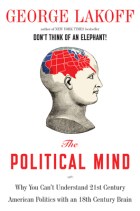
Why You Can’t Understand 21st-Century American Politics with an 18th-Century Brain
In his new book, Lakoff spells out what cognitive science has discovered about reason, and reveals that human reason is far more interesting than we thought it was. Reason is physical, mostly unconscious, metaphorical, emotion-laden, and tied to empathy-and there are biological explanations behind our moral and political thought processes. His call for a New Enlightenment is a bold and striking challenge to the cherished beliefs not only of philosophers, but of pundits, pollsters, and political leaders. The Political Mind is a passionate, erudite, and groundbreaking book that will appeal to anyone interested in how the mind works and how we function socially and politically.
The FrameLab Book Club is launching in 2025! First on the list: “The Political Mind: A Cognitive Scientist’s Guide to Your Brain and Its Politics” by Dr. George Lakoff. Nearly 400 readers have signed up to participate! This online book club will feature personal insights from Dr. Lakoff, as well as an ongoing Q&A with […]
It happened. Donald Trump defeated Kamala Harris. A twice-impeached convicted felon who has promised to act as a dictator will return to the White House in 2025. There’s no way to sugarcoat this nightmare scenario. The consequences of this election will unfold for decades to come. They will likely prove destructive to the very fabric […]
To stay abreast of Dr. George Lakoff’s latest work, please subscribe to the FrameLab Newsletter (it’s totally free!). In the current essay, “Kamala Harris and the Strategy of Joy,” Dr. Lakoff talks about the important role of emotion in political campaigns: “Joy is powerful because it plays on your emotions. And your emotions are everything […]
From George Lakoff and Gil Duran at the FrameLab Newsletter: Moderate and centrist are political weasel words. Their definitions vary widely because there is no such thing as a moderate or centrist ideology. There is no united “middle” or “center” in politics, no single set of ideas on which all moderates or centrists agree. Some […]
Big news: FrameLab just hit a major milestone — 10,000 total subscribers! Thank you so much for reading. If you can afford it, please consider becoming one of our paid subscribers. Because your support makes a big difference. — George and Gil Part 3 in the Moral Warfare 101 series: Ninety-eight percent. That’s an estimate of how much […]
The Story of the Village of Le Chambon and How Goodness Happened There
By: Philip P. Hallie
Publisher: Harper Perennial
Recommended by: Linda H.
“The story of Le Chambon, a Huguenot village in France that saved Jews during WWII, has lived in my heart for years. Imagine my shock and joy to find a You Tube featuring the village as I scrolled through Heather Cox Richardosn’s second traunch of 250 for 250.”
During the most terrible years of World War II, when inhumanity and political insanity held most of the world in their grip and the Nazi domination of Europe seemed irrevocable and unchallenged, a miraculous event took place in a small Protestant town in southern France called Le Chambon. There, quietly, peacefully, and in full view of the Vichy government and a nearby division of the Nazi SS, Le Chambon’s villagers and their clergy organized to save thousands of Jewish children and adults from certain death.